
The simple solution for better maths outcomes.
Connective Fluency is an evidence-based program for developing fluency in basic maths facts and multi-digit computation skills. Designed to supplement a range of curriculums. Freely available for busy schools.
What does Connective Fluency look like?
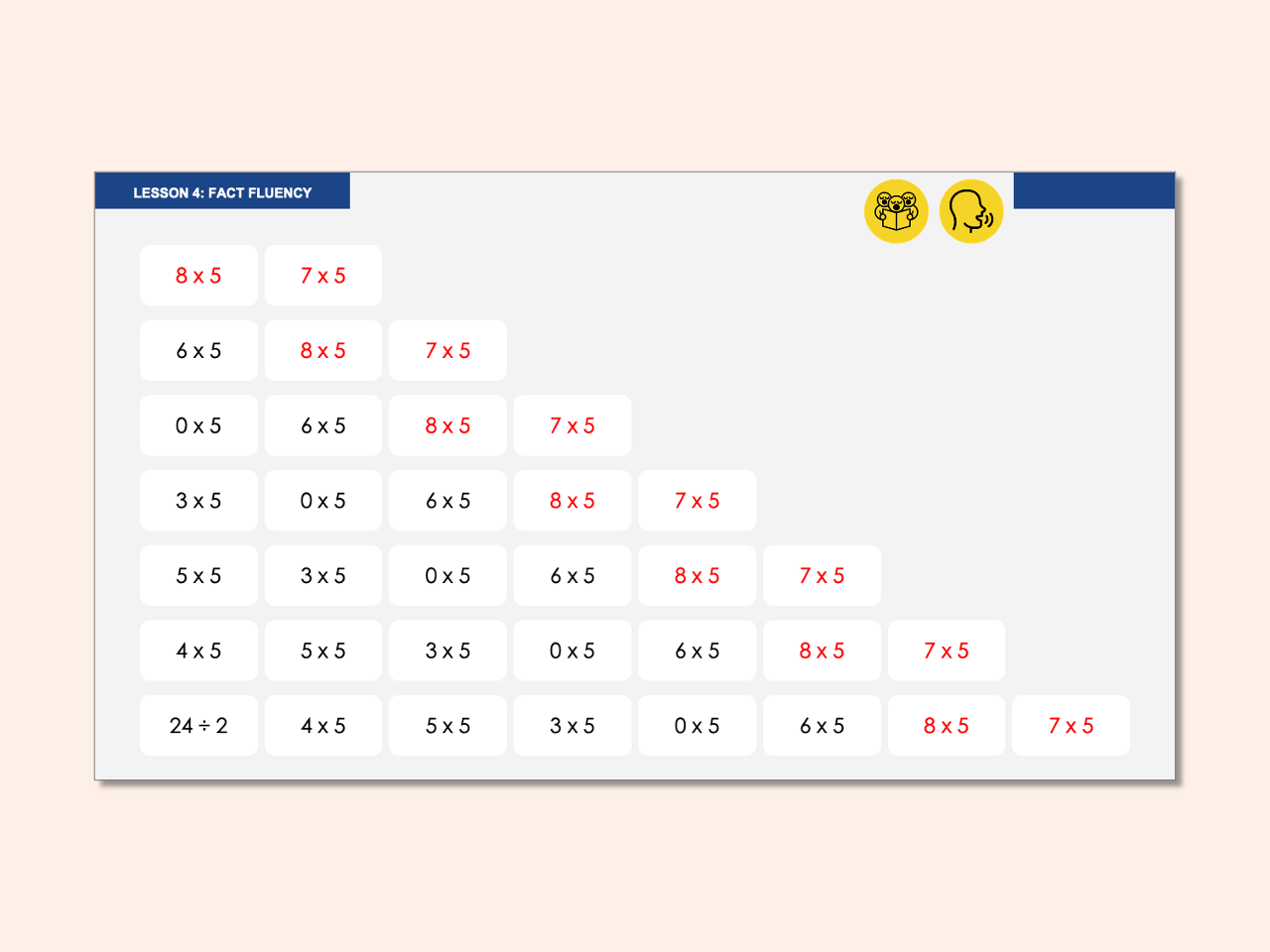
Whole-Class Incremental RehearsalUsing Connective Fluency’s incremental rehearsal slides, the teacher introduces two new facts for students to learn each day, first by applying a known strategy, then memorising them alongside previously learned facts. These resources are useful for initial learning of new facts.
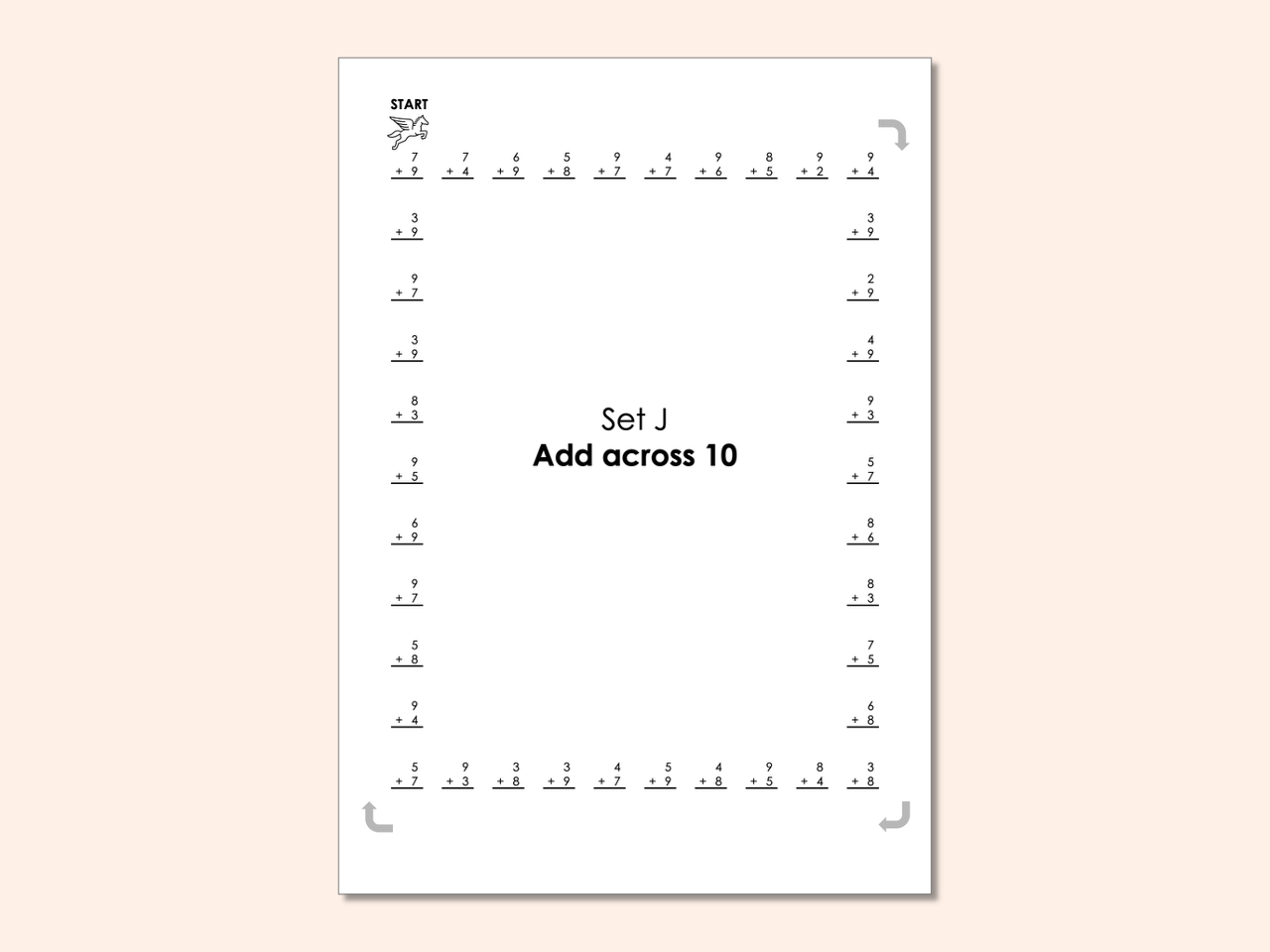
Paired Fluency PracticeUsing Connective Fluency’s fact fluency booklets, students work in pairs to practise a set of facts. One student says the answers to as many questions as possible in 2 minutes. Their partner provides support if they make a mistake or get stuck. These resources are useful for building and maintaining fluency. Spend 5 minutes of classroom time practising every day.
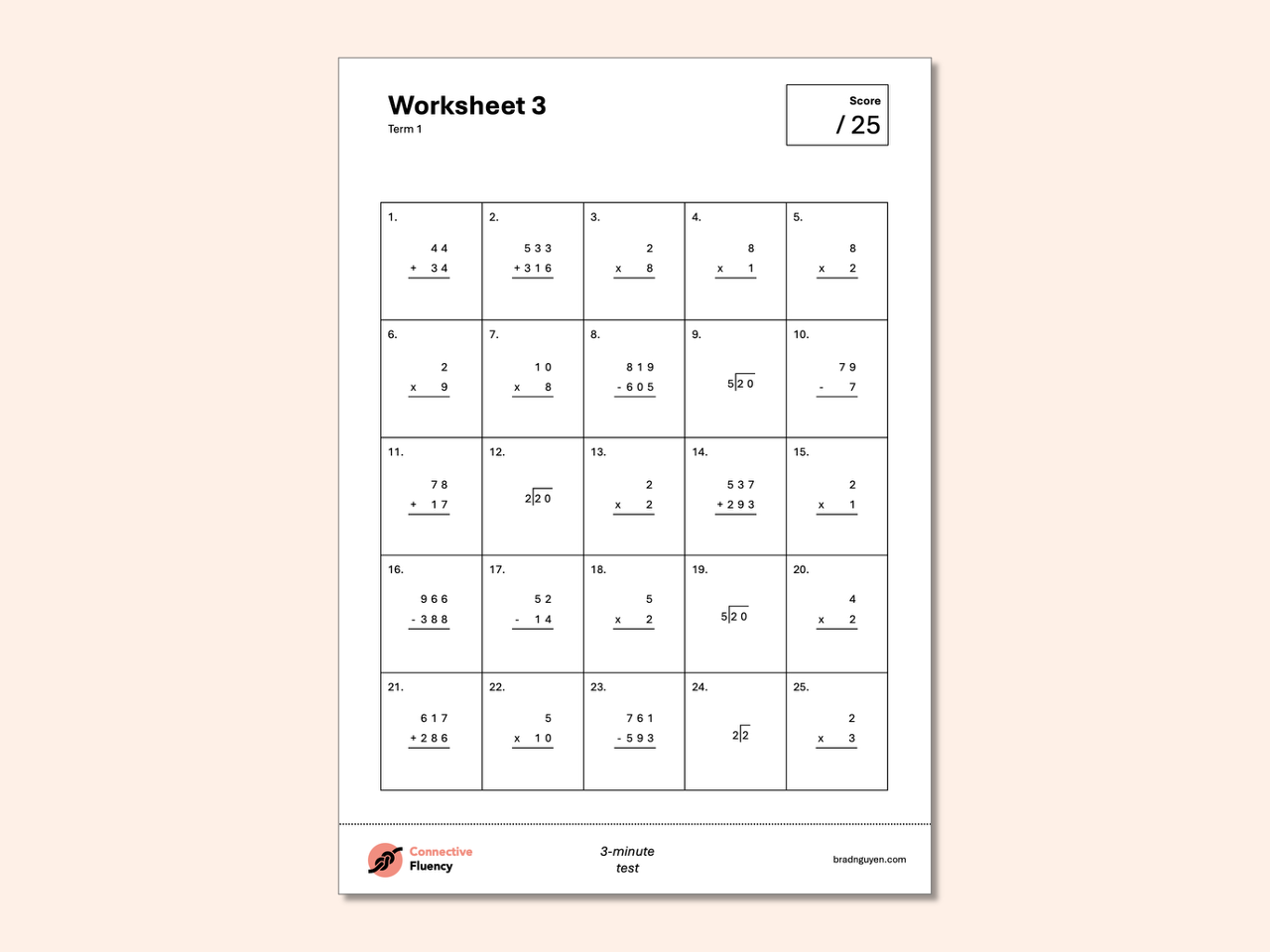
Timed Computation PracticeStudents answer as much as possible on a worksheet from Connective Fluency’s computation booklet in a given time limit. Each worksheet includes a variety of problem types. Scores are recorded by students so that progress can be tracked over time. These resources are useful for building and maintaining fluency in multi-digit computation. Practise once a week/fortnight for 2-6 minutes.
Start with Connective Fluency now.
Connective Fluency resources are free to use. To get started, select the practice type for basic implementation information and fill out the form to access the Connective Fluency Download Page.
-
Download the slides. There are 2 slide decks - one for addition and subtraction, one for times tables.
Teach mental strategies. This needs to happen before incremental rehearsal. Strategies for addition and subtraction are commonly taught in Grade 1 and 2, while strategies for times tables are taught in Grades 2-4.
Include incremental rehearsal in daily review. Plan to use the slides 3-5 days a week, after mental strategies have been taught.
Follow up with fluency practice. After a set of facts have been introduced, continue to practise the same set of facts using paired fluency practice.
-
Download and print the booklets. There are two booklets - one for addition and subtraction, one for times tables. You will need to print one booklet per student. This is an investment, but the booklets will be used every day and can be reused the following year. Print the addition and subtraction booklet for Grades 1 to 6. Print the times tables booklet for Grades 2 to 6.
Download and print the diagnostic assessments. There are two diagnostic assessments - one for addition and subtraction, one for times tables. You will need to print one assessment per student. Print the addition and subtraction diagnostic assessment for Grades 1 to 6. Print the times tables diagnostic assessment for Grades 3 to 6.
Establish a starting point. The fact fluency booklets are organised into sequenced sets of facts. Using the diagnostic assessments, find the first set where less than 80% of students can demonstrate mastery and use that as a class focus. Differentiate for individual students where necessary.
Teach the routine. This is a daily routine, so teach students what each partner does. The person practising should say the problem and the answer. Their partner should be listening and tracking along with their finger. If the student hesitates or makes an error, their partner gives them the answer and prompts them to repeat it 3 times and go back 3 problems.
Practise every day. Each student practises for 2 minutes, so the daily routine should take 4-5 minutes. Students will typically stick with one set for a fortnight to develop fluency.
Change sets when students achieve mastery. Rove and check off students who are demonstrating fluency (under 3 seconds per problem), or use the diagnostic assessment after a fortnight of practice. If 80% of students can demonstrate mastery, and if the next set has been previously introduced through incremental rehearsal or otherwise, progress the class goal to the next set.
-
Download and print the booklets. There are booklets for Grades 1 to 6, each containing enough worksheets for the year. Choose between 20 worksheets (for fortnightly practice) or 40 worksheets (once a week). You will need to print one booklet per student.
Practise regularly. Plan for students to practise computation once a week or once a fortnight as a daily review activity.
Implementation advice for Connective Fluency by grade level
-
Introduce routines for fact fluency and computation. Use the diagnostic assessment for addition and subtraction facts at the start of the year. Introduce daily paired fluency practice for facts taught in the previous year and timed computation practice once a week/fortnight.
Teach addition & subtraction strategies. Early in the year, teach strategies for addition and subtraction within 20. Typically, addition strategies include counting on (e.g. 9 + 2 = 11), using known doubles facts (e.g. 6 + 7 = 13) and bridging ten (e.g. 8 + 6 = 14). Subtraction strategies include counting back, using fact families and bridging ten.
Use incremental rehearsal. After teaching strategies, use the incremental rehearsal slides for addition and subtraction to provide opportunities for students to practise strategies and begin memorising facts bit-by-bit.
Update the focus of paired fluency practice. After using incremental rehearsal to introduce all the facts in a set, change the focus of paired fluency to that set and develop fluency in the new set. Once students have achieved mastery, stay with the set but continue with incremental rehearsal for the next set of facts.
-
Introduce routines for fact fluency and computation. Use the diagnostic assessment for addition and subtraction facts at the start of the year. Introduce daily paired fluency practice for facts taught in the previous year and timed computation practice once a week/fortnight.
Review addition & subtraction strategies. Early in the year, review strategies for addition and subtraction within 20, particularly using known doubles facts and bridging ten.
Use incremental rehearsal sparingly for addition and subtraction. Students can lose fluency over time, but this can often be refreshed quickly using paired fluency practice, rather than incremental rehearsal.
Teach times tables strategies. Later in the year, after confirming fluency in addition and subtraction, teach strategies for times tables of 10 (skip counting), 2 (skip counting or doubling) and 5 (skip counting). Teach students to use fact families for division.
Use incremental rehearsal for times tables. After teaching strategies, use the incremental rehearsal slides for times tables to provide opportunities for students to practise strategies and begin memorising facts bit-by-bit.
Update the focus of paired fluency practice. After using incremental rehearsal to introduce all the facts in a set, change the focus of paired fluency to that set and develop fluency in the new set. Once students have achieved mastery, stay with the set but continue with incremental rehearsal for the next set of facts.
-
Introduce routines for fact fluency and computation. Use the diagnostic assessment for both addition and subtraction facts and times tables at the start of the year. Introduce daily paired fluency practice with an initial focus on addition and subtraction facts before shifting focus to times tables introduced in the previous year (tables of 10, 2 and 5). Introduce timed computation practice once a week/fortnight.
Teach times tables strategies. Early in the year, teach strategies for times tables of 3 (skip counting) and 4 (doubling). Teach students to use fact families for division.
Use incremental rehearsal for times tables. After teaching strategies, use the incremental rehearsal slides for times tables to provide opportunities for students to practise strategies and begin memorising facts bit-by-bit.
Update the focus of paired fluency practice. After using incremental rehearsal to introduce all the facts in a set, change the focus of paired fluency to that set and develop fluency in the new set. Once students have achieved mastery, stay with the set but continue with incremental rehearsal for the next set of facts.
-
Introduce routines for fact fluency and computation. Use the diagnostic assessment for both addition and subtraction facts and times tables at the start of the year. Introduce daily paired fluency practice with an initial focus on addition and subtraction facts before shifting focus to times tables introduced in previous years (tables of 10, 2, 5, 3 and 4). Introduce timed computation practice once a week/fortnight.
Teach times tables strategies. Early in the year, teach strategies for times tables of 8, 6, 7 and 9. Typical strategies include doubling and adding or subtracting from a nearby fact. Teach students to use fact families for division.
Use incremental rehearsal for times tables. After teaching strategies, use the incremental rehearsal slides for times tables to provide opportunities for students to practise strategies and begin memorising facts bit-by-bit.
Update the focus of paired fluency practice. After using incremental rehearsal to introduce all the facts in a set, change the focus of paired fluency to that set and develop fluency in the new set. Once students have achieved mastery, stay with the set but continue with incremental rehearsal for the next set of facts.
-
Introduce routines for fact fluency and computation. Use the diagnostic assessment for both addition and subtraction facts and times tables at the start of the year. Introduce daily paired fluency practice with an initial focus on addition and subtraction facts before shifting focus to times tables. Introduce timed computation practice once a week/fortnight.
Use incremental rehearsal sparingly. Students can lose fluency over time, but this can often be refreshed quickly using paired fluency practice, rather than incremental rehearsal.
Frequently Asked Questions
-
Yes, Connective Fluency is aligned with the Australian Curriculum. The incremental rehearsal slides and fact fluency booklets can be used flexibly to meet the needs of your students. The computation booklets include curriculum-aligned skills, except for the ‘Extension Booklets’ in Grades 4 to 6 which include some above-grade level skills.
-
Elegant design - The resources in Connective Fluency have gone through a subtractive design process to make implementation as simple as possible. For example, while other fluency programs have high ongoing printing demands, the need to print resources in Connective Fluency is kept to a minimum. Booklets are printed for the start of the year and that’s all students will need. Students don’t write in the fact fluency booklets, so they can be used year after year.
Human element - Connective Fluency resources are designed to support human interaction in the classroom. For example, while other fluency programs have students responding to pre-recorded content, in Connective Fluency, students learn by interacting with a teacher (in Whole-Class Incremental Rehearsal) or helping each other (in Paired Fluency Practice).
Instant corrective feedback - Paired Fluency Practice allows all students to practise with instant corrective feedback. In classrooms that rely on whole-class chanting for fluency practice, less confident students can get lost in the crowd. And if students are writing their responses, feedback often arrives too late to make a difference. In Paired Fluency Practice, if a student hesitates or makes an error, their partner instantly gives them the answer and an opportunity to successfully retrieve it from memory.
Manageable differentiation - Other fluency programs have either convoluted systems for differentiation or no differentiation at all. Connective Fluency is designed to provide opportunities for manageable differentiation. In Whole-Class Incremental Rehearsal, teachers can direct more ‘opportunities to respond’ to students who need more repetition. In Paired Fluency Practice, students can practise from different pages in the booklet. For Timed Computation Practice, teachers can provide a different booklet to students who need it. (The computation booklets in Grades 4 to 6 come in ‘Standard’ and ‘Extension’ versions.)
Connecting knowledge - Connective Fluency is designed around the idea that conceptual knowledge aids memorisation and that memorisation aids conceptual understanding. Other fluency programs aim for students to learn facts as disconnected bits of knowledge. In Connective Fluency, students make connections between strategies and fact memorisation through incremental rehearsal and the sequencing of facts is explicitly based around the strategies that students learn, not just the size of the numbers.
-
General Principles
Retrieval Practice - Memory is strengthened when information is successfully retrieved from long-term memory.
Frequent, then Spaced Practice - Learning is enhanced by practising frequently at first, then gradually increasing the intervals between practice opportunities.
Blocked, then Interleaved Practice - Learning is enhanced by practice that is first focused on a specific skill, then problem sets that demand students to switch between different problem types.
Whole-Class Incremental Rehearsal
Conceptual Knowledge & Memorisation - ‘Conceptual knowledge’ refers to connecting facts to other knowledge about numbers through the application of strategies, for example relating 6 + 2 to the number sequence. ‘Memorisation’ refers to automatically and accurately responding to a problem (‘6 + 2’) with the answer (‘8’). The development of conceptual knowledge and memorisation have a bi-directional relationship; they support each other. In Connective Fluency, resources support developing both in tandem.
Incremental Rehearsal - Traditionally, this is an evidence-based flashcard technique for 1-1 intervention. A new fact is taught then practised multiple times, each time after practising a steadily increasing set of previously learned facts. In Connective Fluency, this procedure has been adapted for a whole-class context with 2 facts being introduced at a time and the set of known facts increasing to 6, rather than 9.
Paired Fluency Practice
Corrective Feedback - Feedback is effective when it helps students identify errors and results in students successfully demonstrating the target behaviour. In Paired Fluency Practice, when students make an error, they get immediate feedback and have an immediate opportunity to be successful.
Collaborative Learning - Humans are a social species and are motivated by learning with and from other humans. Paired Fluency Practice capitalises on classroom dynamics by making every student feel accountable to, and supported by, another human.
Timed Computation Practice
Spaced and Interleaved Practice - Regular practice using a worksheet of mixed problems ensures students have opportunities for independently applying knowledge and skills.
Timed Practice and Growth Mindset - Timed activities that occur on a regular basis have 2 benefits. First, they clarify that an important learning goal is to develop fluency, not just accuracy. Second, they allow students to track their progress over time, bringing a concrete sense of how effort leads to improvement.
-
Connective Fluency is designed to take up a portion of the time in a typical maths lesson spent on daily review. Paired Fluency Practice takes about 5 minutes of daily review time every day. Timed Computation Practice occurs once a week or fortnight and takes 5-10 minutes including time to mark in class and record scores.
-
Use a universal screening assessment that assesses fluency in basic maths skills, such as Acadience Math. Look for the percentage of students at or above benchmark in the Acadience Math ‘Computation Fluency’ benchmark assessment to improve over time.
-
The worksheets in the Computation Booklets include mixed problems that are aligned with curriculum expectations, including:
Multi-digit addition and subtraction
Multi-digit multiplication and division (from Grade 3)
Addition and subtraction of fractions and mixed numbers (from Grade 4)
Applying operations to decimals (Grade 6)
The booklets are designed so that the skills progress with each term. The skills in each term reflect what is typically taught prior to or during that term. A specific breakdown of the skills included in the worksheets can be found on the second page of each booklet.
-
There are Extension Booklets for Computation in Grades 4 to 6. Use these if students are achieving above benchmark and if there is capacity to teach these students above-grade level skills.
-
Even after students progress from a set of facts in Paired Fluency Practice, they will continue to encounter those facts in Timed Computation Practice. Think of Paired Fluency Practice as the engine for deliberate practice of specific sets of facts and Timed Computation Practice as the engine for spaced and interleaved practice.
-
Connective Fluency is not a resource for initial instruction in mental strategies or algorithms; it is designed to supplement other curriculums that teach mental and written strategies. For example, the Victorian Lesson Plans’ ‘Additive thinking’ sequences in Foundation and Level 1 teach a comprehensive range of strategies for addition and subtraction within 20. Once these skills have been taught, students need regular ongoing practice in order to develop mastery and that’s where Connective Fluency comes in.