
Behind Connective Fluency’s scope and sequence
The maths fluency resource Connective Fluency is built on a distinctive scope and sequence that sets it apart. Download the scope and sequence and learn about its underpinning design principles.
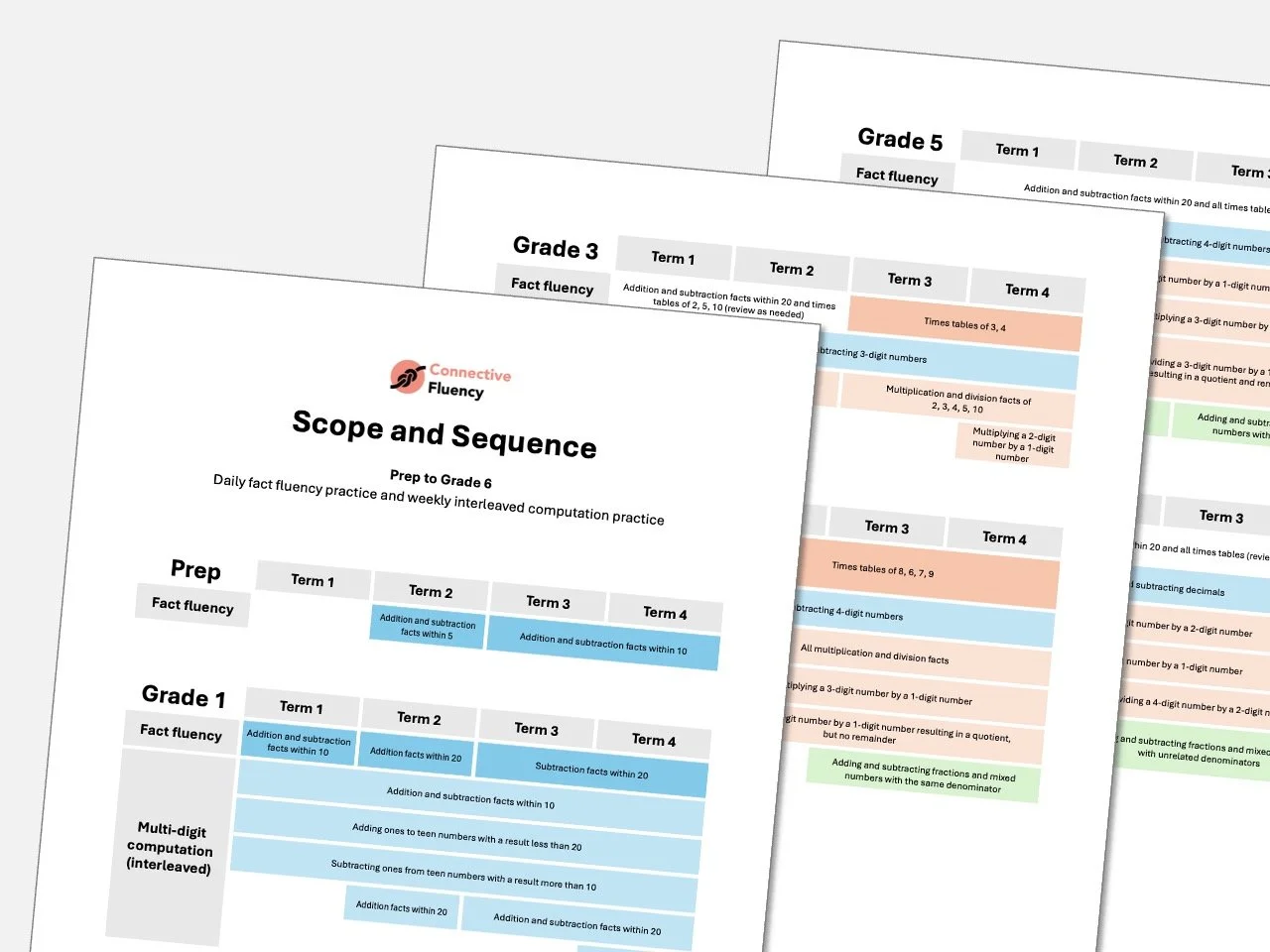
There are many resources available to support fluency in maths, making it hard for schools to choose. In this blogpost, I’m going to explain the design principles behind Connective Fluency’s scope and sequence. This should help schools understand key differences between Connective Fluency and other fluency resources. At the end of the post, I’ll share a link for you to download the scope and sequence.
The design principles
The scope of Connective Fluency is comprehensive:
Addition and subtraction facts within 20
Multiplication and division facts up to the 12 times table
Multi-digit computation
Addition and subtraction of fractions and mixed numerals
The sequence of facts is organised around strategies:
Strategies help students connect facts to other knowledge in long-term memory
Addition and subtraction facts begin with facts within 5, then facts related to counting on and back by 1, 2 or 3. Doubles facts (e.g. 6+6) are introduced before near-doubles (e.g. 6+7). Facts within 10 are secured before facts that involve bridging 10.
Times tables begin with tables that can be derived by skip-counting (10s, 2s, 5s, 3s). These are followed by tables that can be derived by doubling (4s and 8s). The remaining facts (6s, 7s, 9s, 11s, 12s) can be derived by adding or subtracting from other known facts.
New facts are introduced in small chunks:
Facts are introduced bit-by-bit through incremental rehearsal, 2 facts at a time
Practice of all facts and skills are spaced over time
Once facts and skills are introduced, weekly timed computation practice ensures they are practised on a regular ongoing basis all-year-round
Practice of all facts and skills is interleaved
Through timed computation practice, Connective Fluency gives students an opportunity to practise mixed problem sets that switch between addition, subtraction, multiplication and division and require retrieval of all previously learned facts
Connective Fluency develops multi-digit computation alongside fact fluency
In Grade 1, once students have learned addition and subtraction facts within 10, they are introduced to multi-digit addition and subtraction within 20 that does not require regrouping (e.g. 12+5=17)
In Grade 2, once students have learned addition and subtraction facts within 20, they are introduced to multi-digit addition and subtraction that does require regrouping (e.g. 17+18=35)
In Grade 3, once students have learned times tables of 2, 3, 4, 5 and 10, they are introduced to multi-digit multiplication (e.g. 63×2=126)
In Grade 4, once students have learned all times tables, they are introduced to multi-digit division (e.g. 786÷3=262)
Questions to ask of any fluency resource
Does it cover all addition and subtraction facts within 20?
Does it cover all multiplication and division facts at least up to 10×10?
Does it include multi-digit computation?
Does it include fractions?
How many new facts are introduced at once?
Are facts organised and sequenced according to strategies? Does addition begin with adding 1, 2 and 3? Does multiplication begin with the 10 times table?
Are all facts and skills practised all year round? If practice is always blocked (i.e. one skill at a time), students may spend too long neglecting other facts and skills.
When are multi-digit computation skills introduced? Do they develop alongside fact fluency development, or are they delayed?
Download the Scope and Sequence
To download the Connective Fluency Scope and Sequence, click here
Other nerdy considerations
Adding and subtracting with zero
Students need to learn that adding or subtracting zero does not change a number (e.g. 3+0=3) and subtracting a number from itself gives a result of zero (e.g. 5-5=0). Facts that reflect this concept are included in Connective Fluency’s fact fluency booklets in the earliest sets (adding and subtracting within 5). For efficiency, the concept of adding zero is not laboured on after this.
Multiplying and dividing with zero and one
Students also need to learn that multiplying a number by zero gives a result of zero (e.g. 5×0=0) and that dividing a number by itself gives a result of 1 (e.g. 2÷2=1). Facts that reflect this concept are included in Connective Fluency’s incremental rehearsal slides in the earliest sets (multiplying by 10, 2 and 5).
Turn-around facts
Turn-around facts are related addition or multiplication facts that demonstrate commutativity (e.g. 5+3=8 and 3+5=8, or 4×6=24 and 6×4=24). Teaching as efficiently as possible is important, which begs the question: Do we need to explicitly teach both facts or can we teach one fact and get the other ‘for free’?
This question was resolved differently for addition and subtraction facts versus times tables. For addition and subtraction facts, each fact is explicitly taught through the incremental rehearsal slides and practised in the fact fluency booklets. For example, time is taken to introduce both 5+3 and 3+5 as distinct facts.
On the other hand, students learn times tables when they are older and the concept of commutativity is easier to grasp. So in the incremental rehearsal slides, when a multiplication fact is introduced, its turn-around fact is omitted from later tables for efficiency. For example, when students learn the 2 times table, they learn 8×2; when they later learn the 8 times table, the turn-around fact 2×8 is omitted. However, all turn-around facts are present in the fact fluency booklets.
