
The perfect assessments for fact fluency
Download these short assessments to help you see what types of number facts students can fluently recall and what to focus on next.
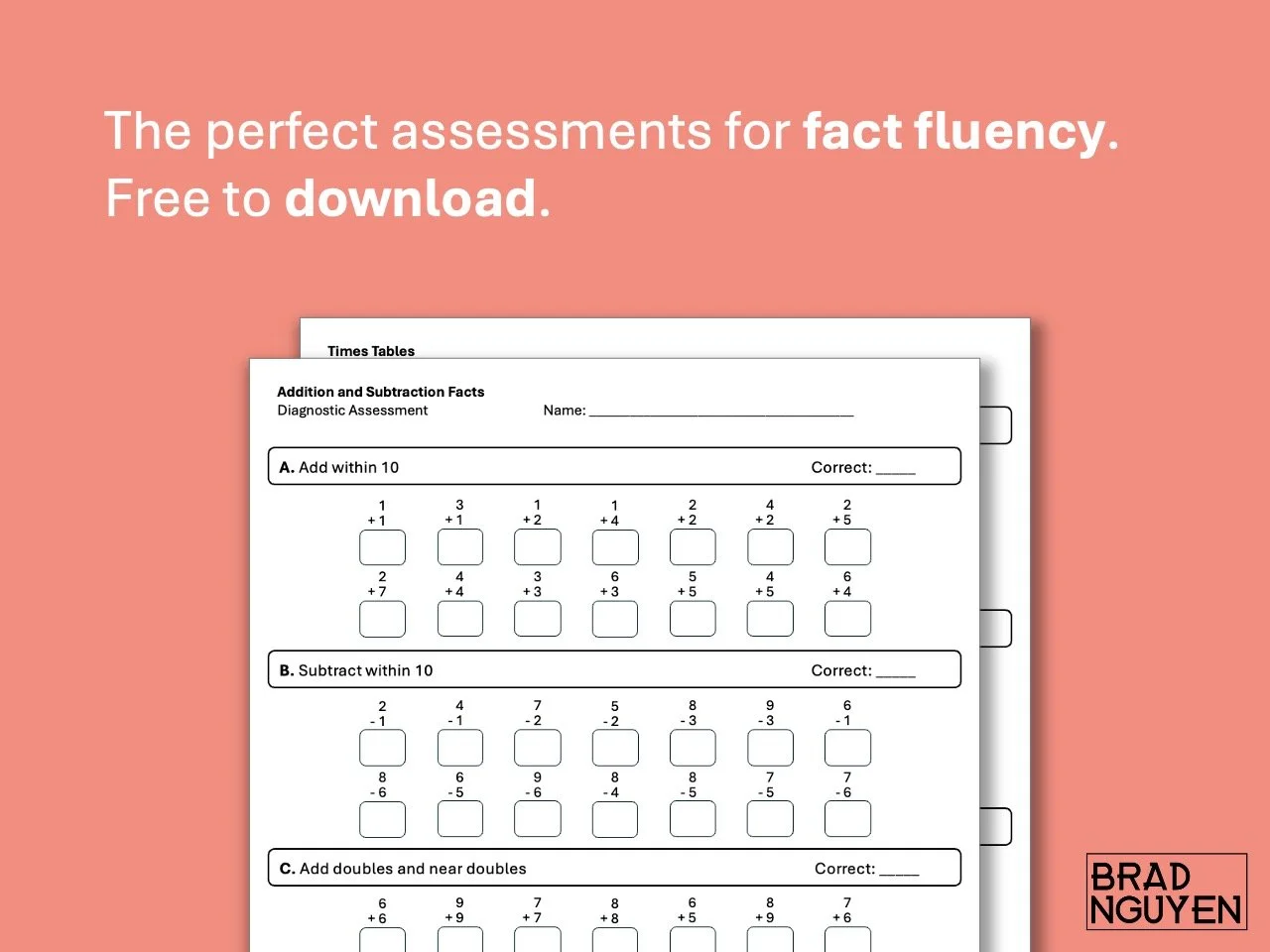
I think there is consensus among teachers that helping students to fluently recall basic facts of addition, subtraction, multiplication and division is important. And yet, I’ve always been a little dissatisfied with the range of assessment tools available and their ability to assess mathematical fact fluency for a few reasons:
They don’t help with next steps - Tests that consist of randomly ordered items are only capable of providing a score. It is more helpful for teachers to have information about strengths and weaknesses. Knowing that a student can quickly add within 10, but can’t fluently recall doubles facts such as 7 + 7 gives teachers a clearer instructional goal.
They focus on written algorithms - Tests that assess fluency in written algorithms are useful, but it is difficult to know whether students are experiencing challenges with the algorithm itself or with the knowledge of number facts needed to execute the algorithm. Having a separate assessment of fact fluency helps build a fuller picture of our students.
They allow students to bank past successes - Assessment formats that work like a stamp rally (i.e. colour in a square in an addition grid when you’ve answered it correctly) don’t account for the reality of forgetting. If you look at a grid of green, you may be forgiven for assuming it represents what students can do now, rather than what they did in the past and have since forgotten. For teachers to make the best decisions about their students, it is better to do a quick assessment that gives an accurate point-in-time picture of the types of facts students are fluent in and where they need more practice.
To help teachers get a better picture of their students’ fact fluency, I’ve developed 2 diagnostic assessments that are efficient and intuitive to use:
How do the diagnostic assessments work?
There are two diagnostic assessments. One for addition/subtraction and one for times tables. Each is organised into mini tests in which students are given 15 seconds to answer as many problems as they can. Here are the addition/subtraction mini-test topics in order of presentation:
Add within 10
Subtract within 10
Add doubles and near doubles
Subtract from doubles and near doubles
Make 10
Subtract from 10
Add across 10
Subtract across 10
The times tables mini-test topics in order are:
Tens
Twos
Fives
Threes
Fours
Eights
Sixes
Sevens
Nines
You can administer an assessment with the whole class, taking 2-3 minutes total.
When marking, you can use the mastery goal to decide whether students have mastered that set of facts or not. The mastery goals for each 15-second mini-test is 5-7 correct responses. That’s about 2-3 seconds per question.
How do you administer the assessments?
Hand out the assessment and get students to write their name at the top.
Explain that the assessment has little mini-tests. In each mini-test, students are given 15 seconds to answer as many questions as possible.
Direct students to do ‘Part A.’ After 15 seconds, make sure students put their pencil down and refrain from answering any more questions.
Repeat with the remaining parts of the assessment.
Have students exchange their test with a partner and mark together.
When should we use them?
For screening assessment purposes, I recommend assessing fact fluency at the start of each semester, depending on year level:
Addition and subtraction from Year 1
Times tables from Year 3
Can I use them for monitoring progress?
If your class was working on developing fluency in a particular set of facts, these assessments can also be used as a kind of exit ticket. For example, your students may be practising doubles facts (e.g. 7 + 7) and near-doubles facts (e.g. 7 + 6). After two weeks, you decide to use the diagnostic assessment of addition and subtraction facts to see if students are fluent or whether they need more practice before progressing to the next set of facts. When using the assessment in this way, you don’t have to do the whole assessment; you can just use the relevant mini-test.
